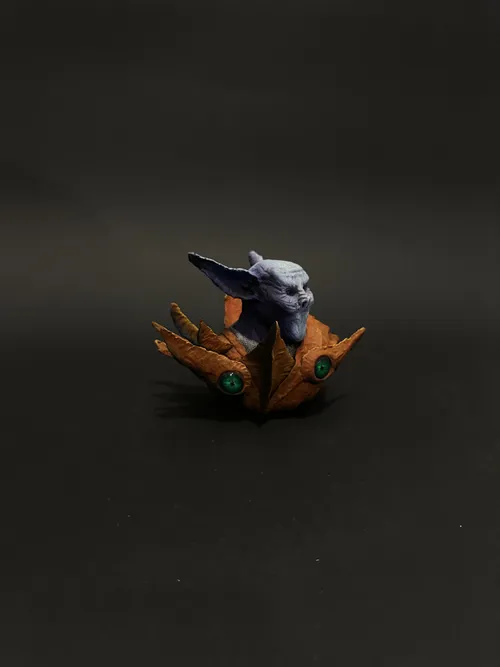
Vampire Bust
This sculpture was a reference-less weekend project, as far as I remember. That is incredibly short for me, since most of my pieces take about two months to finish, but the process here was remarkably fluid with almost no throwaway attempts. I set out to sculpt a vampire and managed to get a pretty good head going, but then came the mouth—which is always difficult for me. Not wanting to ruin the head I had just made, I had a sudden thought: what if I made a mouthless vampire?
It is a fun concept to play with. In vampire lore, is there such a thing as a mouthless vampire? Is there an explanation for how they feed or function? I decided I really liked the mystery of that question, so I went along with it. I kept the armor pretty simple but cool-looking, and this ended up being my shortest sculpting piece to date.
After finishing the sculpt, I watched Vince Venturella's video on painting vampiric skin. He pointed out something interesting: while vampire skin is generally painted by stripping out all the red tones to simulate a pale, dead body, you deliberately add red back into strategic places.
Visually, that red is added for contrast. But the fun part is the lore. Everything—even fantasy, magic, and the supernatural—needs consistent logic and reasoning to exist. So why would a dead creature have those reddish flushed parts in their skin?
Two explanations I came across gave that visual trick an actual physical rationale:
"A vampire's baseline state is a cold, dead corpse. When they feed, they pour piping-hot mortal blood and raw soul-vitality into a frozen container. Because the stone-cold core cannot absorb or integrate that heat, the sudden warmth is forced outward toward the perimeter of the body. The farthest edges—the tip of the nose, the lips, the ear rims, and the knuckles—thaw violently, flushing a raw, wind-burned crimson like frostbitten skin held too close to a fire."
"Living humans have a beating heart that distributes blood into a soft, uniform, full-body complexion. A vampire has no functional heart to regulate pressure; the blood inside them is an inert, heavy fluid moved only by supernatural hunger. Without even circulation, the stolen liquid settles by sheer weight and internal drift into the body's thinnest membranes and peripheral pockets. It leaves the wide planes of the body (cheeks, forehead, chest) chalk-white, while the edges and folds flush deep crimson."
And now, I'm just left trying to figure out how all of this logic actually applies to a vampire without a mouth.
 Drag to rotate · 3D scan